
What Is Deep Learning?
What Is Deep Learning?
What is Deep Learning?
Have you ever wondered what powers ChatGPT? What technology developers are using to create self-driving cars? How your phone can recognize faces? Why it seems like your photos app is better at recognizing your friends’ faces than even you can? What is behind all of this? Is it magic? Well, not exactly; it is a powerful technology calleddeep learning (DL). Let’s dive in and see what this is all about!

A gif of a pig diving into water
Deep Learning vs. Machine Learning
First, let’s focus onlearning. If you have come acrossmachine learningbefore, you might be familiar with the concept of alearning model. Learning describes the process by which models analyze data and finds patterns. A machine learning algorithm learns from patterns to find the best representation of this data, which it then uses to make predictions about new data that it has never seen before.
Deep learning is a subfield of machine learning, and the concept oflearningis pretty much the same.
- We create our model carefully
- Throw relevant data at it
- Train it on this data
- Have it make predictions for data it has never seen
Deep learning models are used with many different types of data, such as text, images, audio, and more, making them applicable to many different domains.
What does “deep” mean?
That leaves the question: what is this “deep” aspect of deep learning? It separates deep learning from typical machine learning models and why it is a powerful tool that is becoming more prevalent in today’s society.
The deep part of deep learning refers to the numerous “layers” that transform data. This architecture mimics the structure of the brain, where each successive layer attempts to learn progressively complex patterns from the data fed into the model. This may seem a bit abstract, so let’s look at a concrete example, such as facial recognition. With facial recognition, a deep learning model takes in a photo as an input, and numerous layers perform specific steps to identify whose face is in the picture. The steps taken by each layer might be the following:
- Find the face within the image using edge detection.
- Analyze the facial features (eyes, nose, mouth, etc.).
- Compare against faces within a repository.
- Output a prediction!
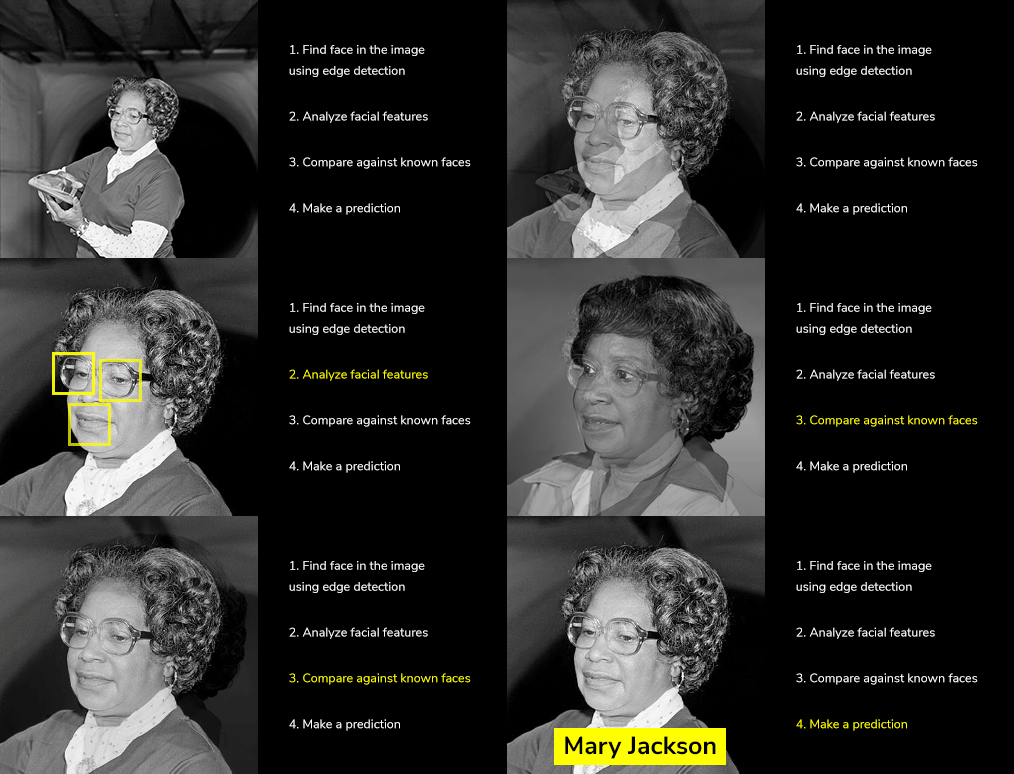
A gif that shows the process of facial recognition: a face is identified and the features of that face are analyzed and tested against existing faces in a repository.
This structure of many abstract layers makes deep learning incredibly powerful. Feeding high volumes of data into the model makes the connections between layers more intricate. Deep learning models tend to perform better with more massive amounts of data than other learning algorithms.
High Volume of Data
Notice that without large amounts of data, deep learning models are no more powerful (and maybe even less accurate) than less complex learning models. However, with large amounts of data, deep learning models can improve performance to the point that they outperform humans in tasks such as classifying objects or faces in images or driving. Deep learning is fundamentally a future learning system (also known as representation learning). It learns from raw data without human intervention. Hence, given massive amounts of data, a deep learning system will perform better than traditional machine learning systems that rely on feature extractions from developers.
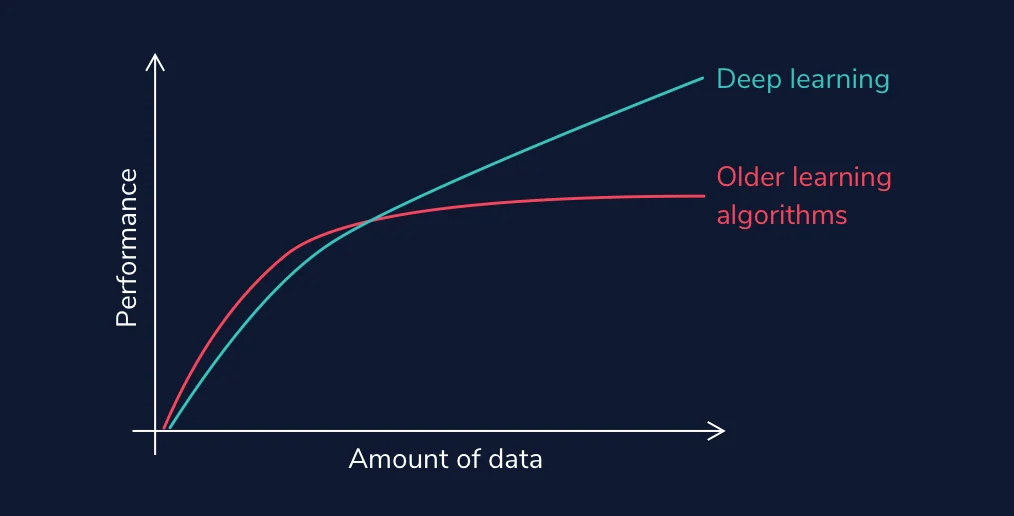
A learning model performance graph comparing machine learning and deep learning
Autonomous vehicles, such as Tesla, have to process thousands, even millions of stop signs, to understand that cars are supposed to stop when they see a red hexagon with “Stop” written on them (and this is only for U.S. stop signs!). Think about the enormous number of situations a self-driving vehicle must train on to ensure safety.
With Deep Learning Comes Deep Responsibility
Even beyond identifying objects, deep learning models can generate audio and visual content that is deceivingly real. They can modify existing images, such as inthis cool appletthat allows you to add in trees or alter buildings in a set of photos. However, they can have a darker side. DL models can produce artificial media in which the identity of someone in an image, video, or audio is replaced with someone else. These are known asdeepfakes, and they can have scary implications, such asfinancial fraudand the distribution of fake news and hoaxes.

A deep fake Nicolas Cage's face being mapped over Amy Adam's face from a scene in Man of Steel
Graphics Processing Units
One final thing to note about deep learning is that with large amounts of data and layers of complexity, you may imagine that this takes a lot of time and processing power. That intuition would be correct. These models often require high-performanceGPUs(graphics processing units) to run in a reasonable amount of time. These processors have a large memory bandwidth and can process multiple computations simultaneously. CPUs can run deep learning models as well; however, they will be much slower.
The development of GPUs has been critical to the success of deep learning. It is interesting to note that one of the driving factors for this development was not the need for better deep learning tools, but thedemand for better video game graphics. It just so happened that GPUs are perfect for processing large datasets. This makes them a perfect tool for learning models and has put deep learning specifically at the forefront of machine learning conversations.
We have only just begun our dive into deep learning. Let’s keep digging in and see where our journey takes us!
'The Codecademy Team, composed of experienced educators and tech experts, is dedicated to making tech skills accessible to all. We empower learners worldwide with expert-reviewed content that develops and enhances the technical skills needed to advance and succeed in their careers.'
Complete Payment to Unlock Full Guide & Source Code
You are viewing the 30% preview. Join TopCourseAI Pro to unlock the remaining 70% of this article, unblur all code snippets, and gain full access to all 412 technical projects and guides.
Ready to access the complete step-by-step tutorial?
Gain full unhindered access to all 412 technical projects and guides, unblur all source code snippets, and download runnable scripts.
Related Blueprints & Guides
View all 166 →Creating a Word Cloud With Python
In Data Visualization,word cloudsare used to display textual data in a specific shape. The more frequent a word is in a chunk of text, the larger it will appear in the word cloud. This can provide interesting insights in...
Data visualizationData Visualizations for Messy Data
Data visualization tutorials generally use pre-processed data. But what about datasets in the wild? What do we do about missing data? Or outliers that largely skew visualizations? What do we do when there are too many ob...
Data visualizationEDA Prior To Fitting a Regression Model
Before fitting any model, it is often important to conduct an exploratory data analysis (EDA) in order to check assumptions, inspect the data for anomalies (such as missing, duplicated, or mis-coded data), and inform fea...
Ready to build production-grade AI systems?
Enjoyed this guide? Continue exploring our library of 166+ production blueprints, multi-agent swarms, and autonomous agent systems with 100% unblurred, executable source code.