
Google VaultGemma: A Guide to Privacy-First LLMs
Google VaultGemma: A Guide to Privacy-First LLMs
AI models are evolving across industries as powerful tools, but the question about how to keep private data safe still hangs over its use. Traditional large language models memorize and reveal parts of their training data at times, which creates risks in fields like healthcare, finance, legal services, etc.
To address this, Google introduced VaultGemma, which builds privacy into the model from the start. With a billion parameters and differential privacy at its core, it shows that powerful AI can also be responsible and secure. Let's understand what it is in detail.
What is Google VaultGemma?
Google VaultGemma is part of the Gemma family of large language models, built with about one billion parameters. What sets it apart is its focus on privacy from the very beginning rather than as an afterthought. The model is designed to keep sensitive information safe while still delivering the kind of text generation and reasoning that modern AI is known for.
This makes VaultGemma valuable for fields where data protection is critical. For example, in healthcare, it can support medical documentation without risking patient records. In the finance and legal settings, it enables organizations to benefit from AI while complying with the strict privacy rules.
VaultGemma is also openly available through platforms like Hugging Face, making it easy for everyone to test, experiment, and push forward the conversation about what a responsible AI should look like.
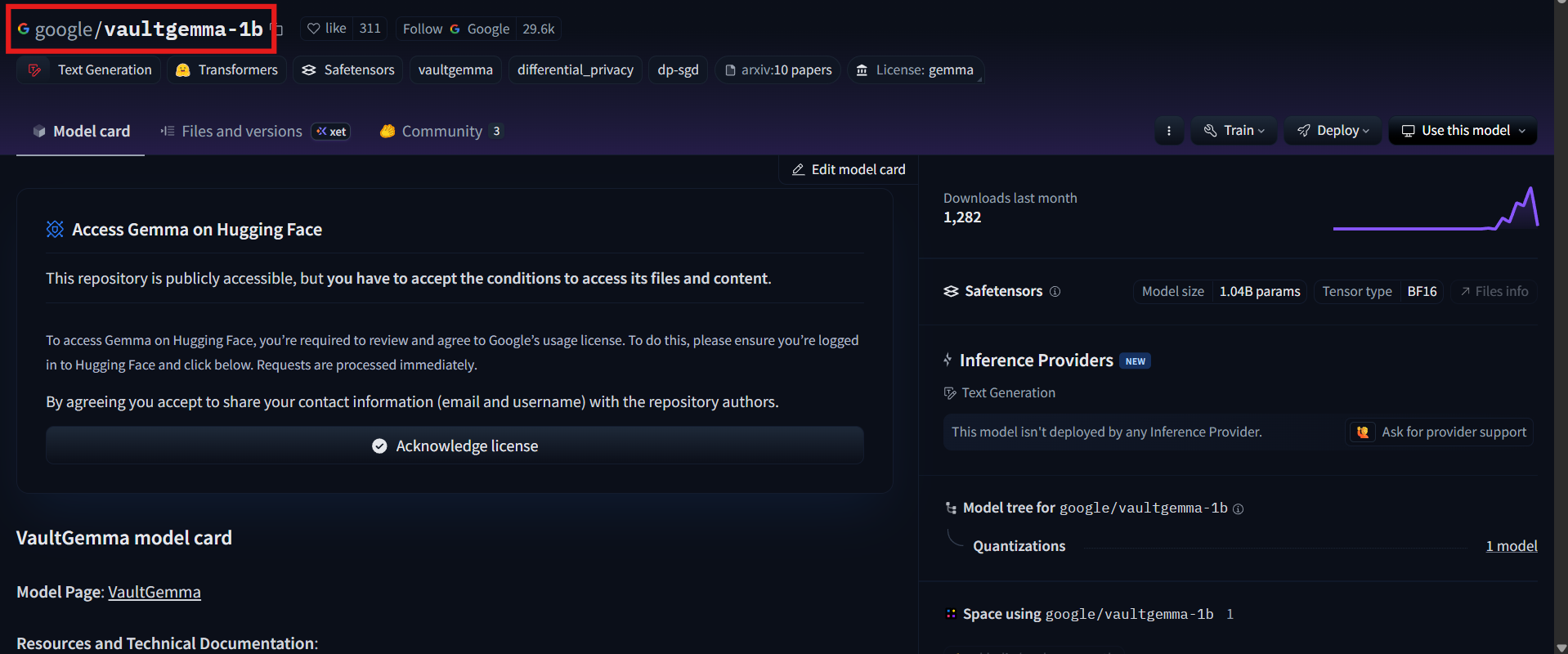
VaultGemma 1B model available on Hugging Face, showcasing access to state-of-the-art open-source AI.
But why did Google even need to build something like VaultGemma in the first place?
What is the privacy challenge in AI?
We use AI in everyday tasks, often forgetting that these systems can sometimes hold on to sensitive bits of information. At times, these systems can memorize details, resulting in the model recalling the parts of personal information, confidential business notes, or medical records.
For fields such as healthcare, finance, or law, even a small slip can have big consequences. A hospital cannot let patient records leak, and a bank cannot afford accidental exposure of data transaction. In many existing models, privacy is treated like an afterthought, added only once the training is finished.
VaultGemma takes the opposite route. It starts with privacy at the core, making sure the model is designed to protect data from the ground up.
So how exactly does VaultGemma build this wall of privacy into its design? The answer lies in a method called differential privacy, a framework that reshapes how data is handled during training.
What is differential privacy (DP)
Differential privacy is a way of training AI models, so they learn general patterns without exposing the specifics of any individual example in the training set. In simple terms, it ensures the model can answer questions without "spilling the secrets."
VaultGemma achieves this through a process known as Differentially Private Stochastic Gradient Descent (DP-SGD). Two core techniques make this work. First, gradient clipping limits how much influence any single training example can have on the model's learning. Second, carefully calibrated noise is added during training to blur out traces of individual data points. Together, these steps make it mathematically improbable for the model to recall or reveal sensitive details.
VaultGemma is trained with protections at the sequence level, think of it as guarding stretches of up to 1,024 tokens at a time. This means even longer chunks of text remain private, not just isolated words or phrases.
Differential privacy is described using parameters ε (epsilon) and δ (delta). They define the balance between privacy strength and model utility, measuring how protective the training is.
Now that we understand how VaultGemma protects privacy, let's take a closer look at what's under the hood and how the model is built.
Architecture and key specs of Google VaultGemma
VaultGemma keeps things compact while staying useful for real-world tasks. It follows the Gemma family's transformer-based design but is trained with differential privacy baked in at every stage. Here are the essentials:
- Family: Gemma-2 style architecture, which is available as a pretrained base with the option to instruction-tune
- Parameters: 1 billion
- Context Window: 1,024 tokens
- Training: Differentially private weights with DP-SGD
- Use Cases: General reasoning, short document QA, privacy-sensitive workflows
- Availability: Open access via Hugging Face for research and experimentation
Family: Gemma-2 style architecture, which is available as a pretrained base with the option to instruction-tune
Parameters: 1 billion
Context Window: 1,024 tokens
Training: Differentially private weights with DP-SGD
Use Cases: General reasoning, short document QA, privacy-sensitive workflows
Availability: Open access via Hugging Face for research and experimentation
As for the benchmarks, VaultGemma was evaluated on a set of academic benchmarks. As expected, there's a performance trade-off for the strong privacy guarantees, but the results still show practical utility.
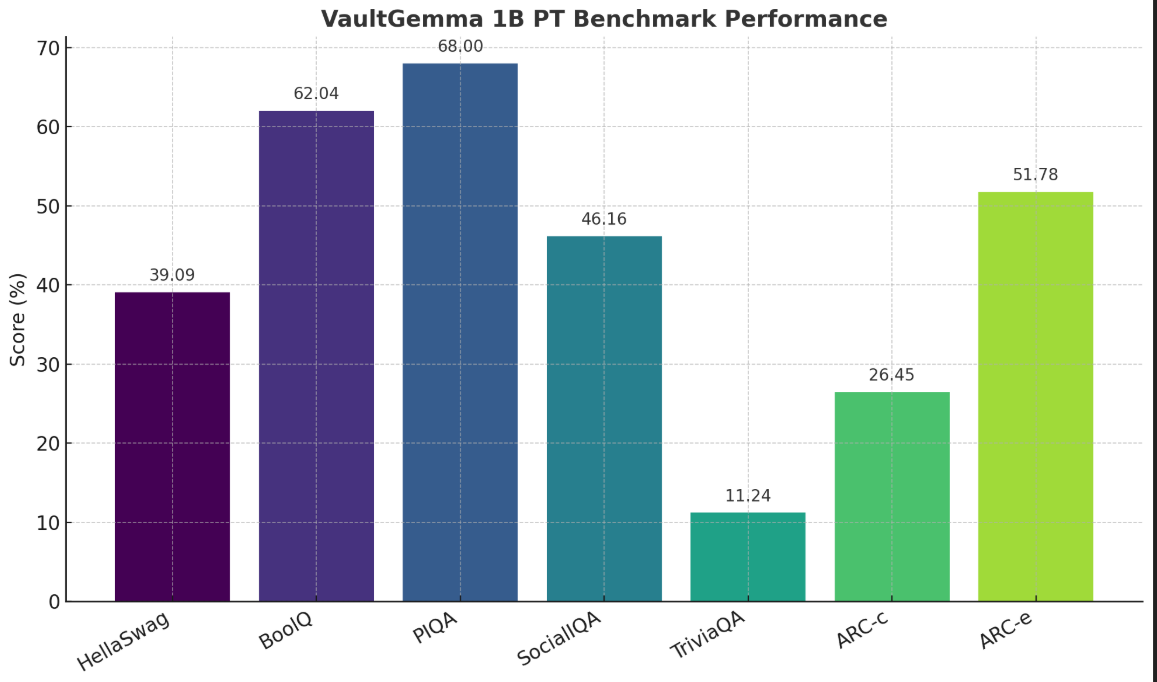
Benchmark performance of VaultGemma 1B across HellaSwag, BoolQ, PIQA, SocialQA, TriviaQA, ARC-c, and ARC-e, displayed in bar graph scores.
It's also helpful to understand how these numbers stack up against other models trained with and without privacy safeguards.
The image here compares VaultGemma 1B, trained with differential privacy, to its non-private sibling Gemma3 1B and to the older GPT-2 1.5B baseline. The results highlight the trade-offs of building privacy directly into training while showing that today's DP methods can still achieve performance levels similar to non-private models from several years ago.
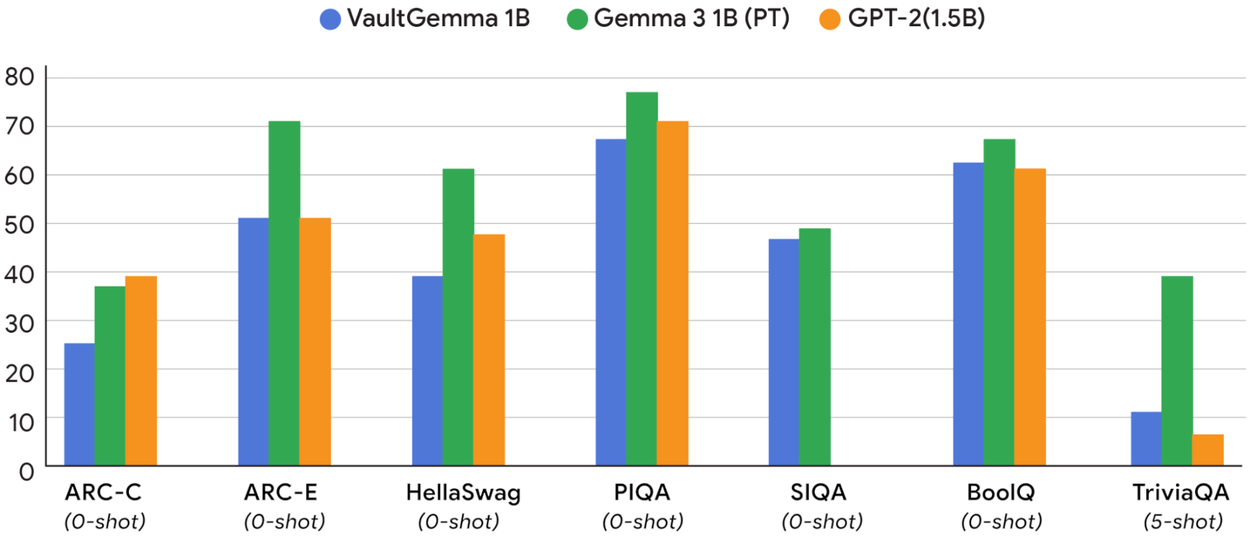
Performance comparison of VaultGemma 1B with Gemma3 1B and GPT-2 1.5B, highlighting trade-offs in differentially private training vs. older baselines.
So, the real question is, how can you try it out yourself and see privacy-first AI in action?
Getting started with VaultGemma
Getting started with VaultGemma is straightforward thanks to its open availability on Hugging Face. You can set-up VaultGemma in three basic steps:
- Step 1: Install the required libraries
- Step 2: Download and load the model
- Step 3: Experiment with the prompts
Step 1: Install the required libraries
Step 2: Download and load the model
Step 3: Experiment with the prompts
Let's look at these steps in detail:
Step 1: Install the required libraries
To use VaultGemma, first install the Hugging Face transformers library and PyTorch. We're also installing kagglehub to fetch models directly from Kaggle's model hub, which simplifies downloading and managing large model files.
pip install transformers pip install kagglehubOr, if you are performing this on a web IDE:
!pip install git+https://github.com/huggingface/transformers@v4.56.1-Vault-Gemma-preview -qStep 2: Download and load the model
Once the environment is ready, the next step is to load the VaultGemma model into your project. Using kagglehub, we can easily download the 1B parameter model and then initialize it with Hugging Face's transformers for tokenization and inference.
import kagglehub  from transformers import AutoTokenizer, AutoModelForCausalLM
# Download the VaultGemma 1B model  MODEL_PATH = kagglehub.model_download("google/vaultgemma/transformers/1b")
# Load tokenizer and model  tokenizer = AutoTokenizer.from_pretrained(MODEL_PATH)  model = AutoModelForCausalLM.from_pretrained(MODEL_PATH, device_map="auto", dtype="auto")
Step 3: Experiment with the prompts
With the model loaded, this step shows how to feed in a prompt, run inference, and decode the output into readable text. The generate method handles text generation, while the tokenizer ensures the input and output are in the correct format.
text = " Explain differential privacy in simple terms. "  input_ids = tokenizer(text, return_tensors="pt").to(model.device)
outputs = model.generate(**input_ids, max_new_tokens=100) print(tokenizer.decode(outputs[0]))
From here, you can start experimenting with more complex prompts, fine-tune the model for your specific tasks, or integrate it into larger projects.
That's all it takes to get started with VaultGemma. Next, let's explore the practical capabilities and performance insights of this model.
Performance insights
VaultGemma is designed with privacy in mind, which comes with a small performance trade-off compared to traditional non-private large language models. Understanding these nuances will help you choose the right use cases and set realistic expectations. Here's how VaultGemma compares to other LLMs:
There's a term coined called the "privacy tax", which means VaultGemma might be slightly less fluent or detailed in some tasks, but it ensures sensitive information stays protected. VaultGemma excels at tasks such as:
- Short-context document QA: Answering questions from internal documents or private datasets.
- Internal knowledge summarization: Summarizing company memos, reports, or confidential notes.
- Confidential interactions: Chat or response generation where data privacy is critical
Short-context document QA: Answering questions from internal documents or private datasets.
Internal knowledge summarization: Summarizing company memos, reports, or confidential notes.
Confidential interactions: Chat or response generation where data privacy is critical
With performance insights in mind, it's time to step back and look at VaultGemma's overall strengths and limitations.
Strengths and limitations of VaultGemma
Here's what makes it stand out and where you might hit some trade-offs:
- Privacy-focused design: Differential privacy ensures sensitive information is protected without exposing training data.
- Practical for internal tasks: Excels at short-context QA, summarization, and confidential interactions.
- Open research and transparency: Its open availability on Hugging Face promotes experimentation, reproducibility, and community contributions.
- Easy to integrate: Compatible with Hugging Face transformers and Python pipelines, making it simple to use in real projects.
Privacy-focused design: Differential privacy ensures sensitive information is protected without exposing training data.
Practical for internal tasks: Excels at short-context QA, summarization, and confidential interactions.
Open research and transparency: Its open availability on Hugging Face promotes experimentation, reproducibility, and community contributions.
Easy to integrate: Compatible with Hugging Face transformers and Python pipelines, making it simple to use in real projects.
- Slight performance trade-off: The privacy measures can slightly reduce fluency and detail compared to traditional LLMs.
- Limited long-context generation: Best suited for short to medium-length inputs rather than extended creative content.
- Dependent on hardware: The 1B model still requires moderate GPU resources for smooth inference.
Slight performance trade-off: The privacy measures can slightly reduce fluency and detail compared to traditional LLMs.
Limited long-context generation: Best suited for short to medium-length inputs rather than extended creative content.
Dependent on hardware: The 1B model still requires moderate GPU resources for smooth inference.
VaultGemma shows that strong privacy and practical AI can coexist. Whether you're experimenting with prompts, summarizing confidential docs, or exploring privacy-first solutions, it's a hands-on way to experience the next generation of responsible language models.
Conclusion
VaultGemma demonstrates how privacy-first design can be integrated into powerful language models without sacrificing practicality. From easy setup and prompt experimentation to effective handling of short-context QA, internal document summarization, and confidential interactions, this model balances performance with strong data protection. By understanding its capabilities, performance trade-offs, and best-use scenarios, readers can make informed decisions about incorporating privacy-conscious AI into their projects.
For those looking to sharpen their knowledge with generative AI and privacy-focused models, our Learn Prompt Engineering course provides step-by-step guidance.
Frequently asked questions
1. What is VaultGemma?
VaultGemma is a privacy-first large language model (LLM) developed to perform tasks like short-context question answering, internal document summarization, and confidential interactions while ensuring sensitive data remains protected.
2. What is Google Gemma used for?
Google Gemma is a generative AI model designed for a variety of natural language tasks, such as text generation, summarization, and answering questions. VaultGemma is a variant that emphasizes privacy.
3. What is Google Vault used for?
Google Vault is a separate service for data retention, eDiscovery, and compliance within Google Workspace. It helps organizations manage, archive, and search emails and documents securely.
4. How to get Google Gemma?
VaultGemma is available on Hugging Face and can be accessed using libraries like transformers and kagglehub. For restricted or private versions, you may need to accept licensing terms or use Kaggle API credentials.
5. Is Google Gemma open source?
VaultGemma is open for research and experimentation through Hugging Face, but the underlying Google Gemma model may not be fully open source. VaultGemma provides transparency for learning and experimentation while maintaining privacy safeguards.
'The Codecademy Team, composed of experienced educators and tech experts, is dedicated to making tech skills accessible to all. We empower learners worldwide with expert-reviewed content that develops and enhances the technical skills needed to advance and succeed in their careers.'
- What is Google VaultGemma?
- What is the privacy challenge in AI?
- What is differential privacy (DP)
- Architecture and key specs of Google VaultGemma
- Getting started with VaultGemma
- Performance insights
- Strengths and limitations of VaultGemma
- Conclusion
- Frequently asked questions
Complete Payment to Unlock Full Guide & Source Code
You are viewing the 30% preview. Join TopCourseAI Pro to unlock the remaining 70% of this article, unblur all code snippets, and gain full access to all 412 technical projects and guides.
Ready to access the complete step-by-step tutorial?
Gain full unhindered access to all 412 technical projects and guides, unblur all source code snippets, and download runnable scripts.
Google Opal: Google's No-Code Tool for Building AI Apps
Next BlueprintGrids in SwiftUI
Related Blueprints & Guides
View all 166 →A Complete Guide to Vercel's AI SDK
Vercel AI SDK is a powerful TypeScript-first toolkit that provides a unified interface for building AI applications with Next.js and other modern frameworks. It eliminates the traditional complexity of managing multiple ...
AI Agents & AutomationAG-UI: How the Agent-User Interaction Protocol Works
AG-UI (Agent-User Interaction Protocol) is an open, lightweight protocol that standardizes the way AI agents interact with frontend apps. Consider it a common language that eliminates the need for custom integration code...
Generative AI FoundationsAI vs Generative AI: Understanding the Difference
Artificial Intelligence, or AI, is everywhere, from chatbots helping you shop to recommendation engines suggesting your next binge. Yet not all AI is the same, and the term is often used loosely, leaving many confused be...
Ready to build production-grade AI systems?
Enjoyed this guide? Continue exploring our library of 166+ production blueprints, multi-agent swarms, and autonomous agent systems with 100% unblurred, executable source code.