
Translate Code into Different Languages with ChatGPT
Translate Code into Different Languages with ChatGPT
Introduction
Translating code from one programming language to a different one is a necessary task. This can be because you stumble upon code in a different programming language or need to translate a codebase from one language to another. Luckily, ChatGPT is available to help you translate your code into another programming language!
In this article, we will walk through an example on using ChatGPT to translate Python code to Java code. We will use the famous Factorial algorithm as our source code. We will set the context for the ChatGPT, provide it our code to translate, and lastly, ask ChatGPT to perform the code translation.
As we use ChatGPT to translate code, let's remember that ChatGPT may hallucinate. We should be cautious and verify the translated code and its output provide the intended result.
Translate Python Code Using ChatGPT
Let's iterate through the list of requests and deliverables using ChatGPT:
- We'll narrow ChatGPT's scope by telling it that we want to translate code from Python to Java
- We'll provide the Python code
- We'll request a thorough code description from ChatGPT to ensure that it matches our Python code
The example in this tutorial will be short, specifically, a single function. Because of this, we will be able to provide the entirety of the source code to ChatGPT at one time; however, it is likely that most of the code you translate will be contained within multiple functions, classes, and even across multiple files. In these cases, it is best to translate objects consistent with the object-oriented programming style, ultimately leading to better translation results.
Let's begin by setting the context for ChatGPT to translate Python code to Java.

Image of Prompt for ChatGPT to set context for translating code

Image of Response for ChatGPT responding to context set
We will now provide the code for ChatGPT to translate from Python to Java.
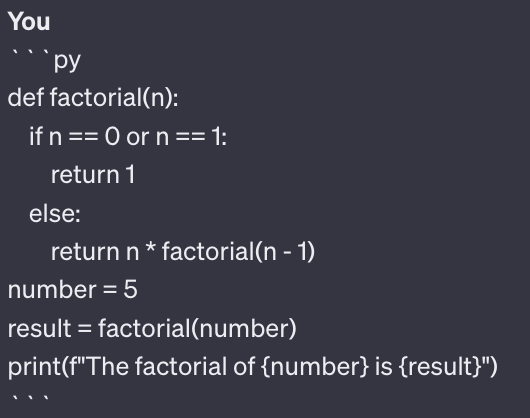
Image of Prompt to provide Python code to ChatGPT
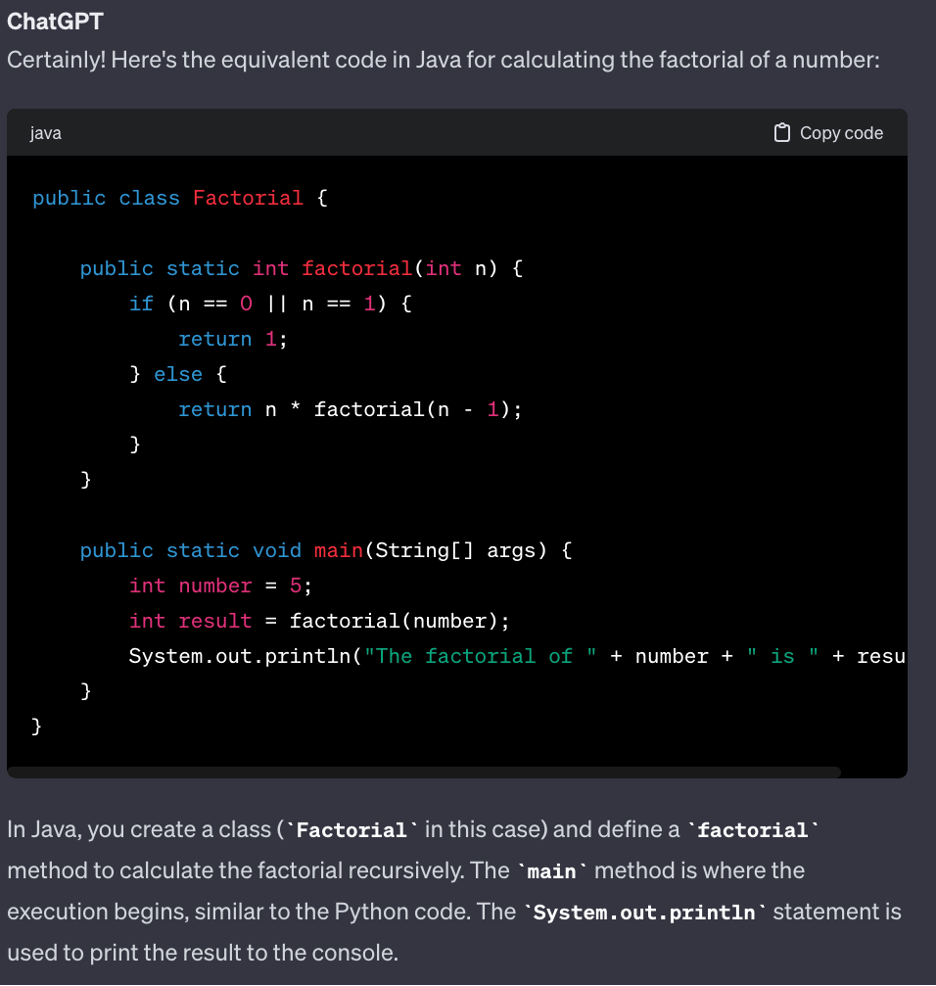
Image of Response from ChatGPT providing the translated Java code
Although it describes the Factorial class briefly, it doesn't provide a thorough explanation of the code. Let's request an in-depth description of the codebase.

Image of Prompt for ChatGPT to provide explanation of the translated java code
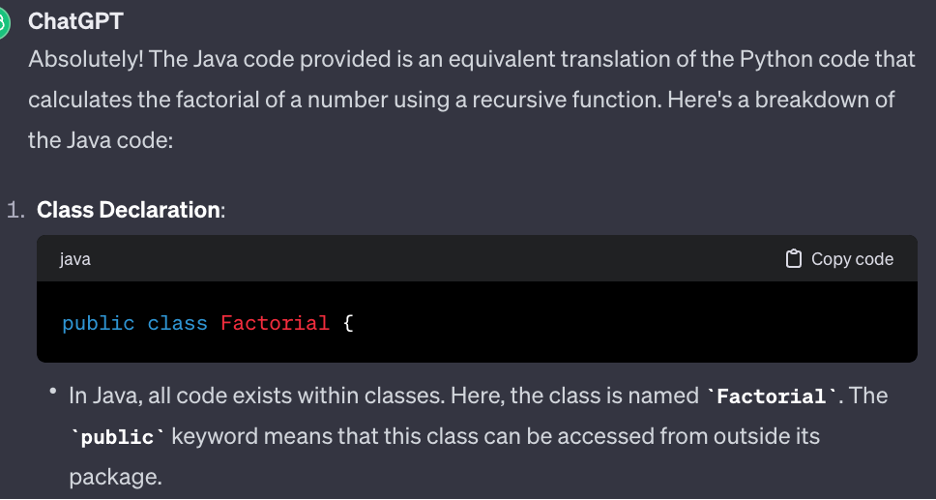
Image one of three ChatGPT responses providing ChatGPT explanation of the translated java code
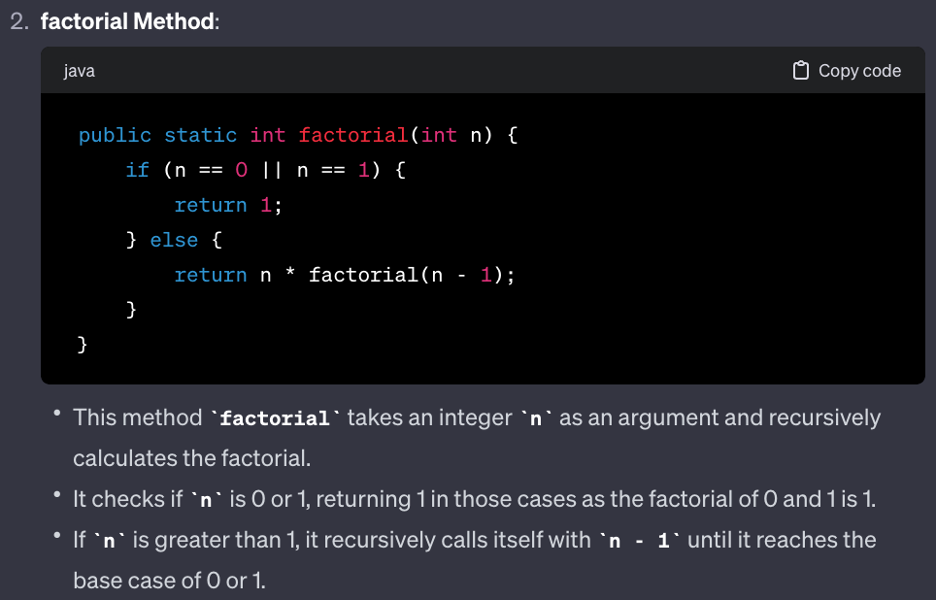
Image two of three ChatGPT responses providing ChatGPT explanation of the translated java code
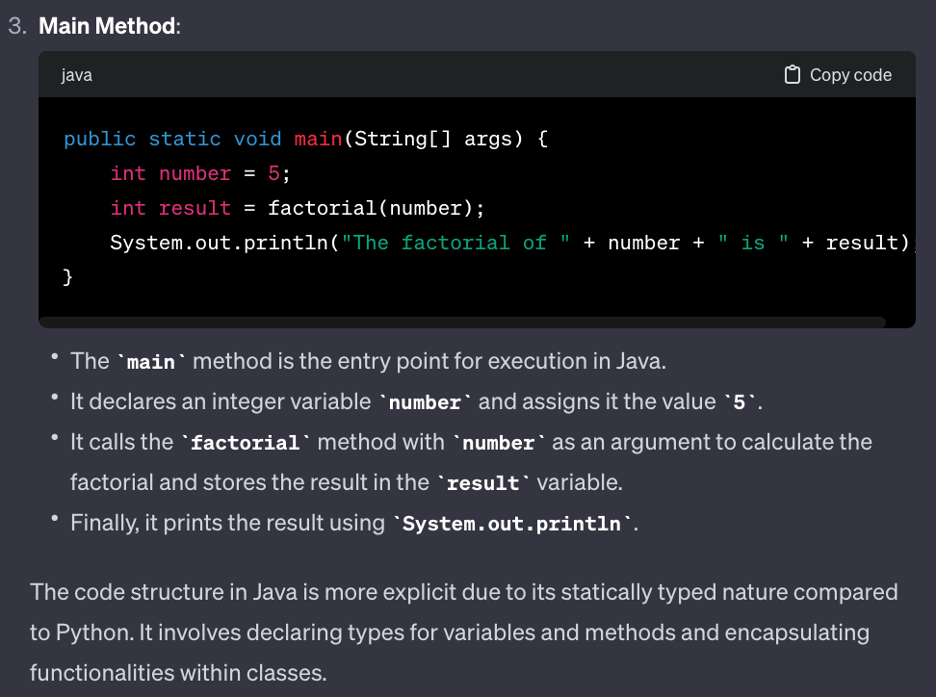
Image three of three ChatGPT responses providing ChatGPT explanation of the translated java code
ChatGPT provided a line-by-line analysis of the code translation from Python to Java. Although it may be difficult, we still need to try and make sure it is correct. For example, do we need a Factorial class and a factorial() function? In Java's case, yes. You cannot run a function without a class container.
Great work! We were able to properly set the context for ChatGPT, provide the Factorial codebase so ChatGPT could translate from Python to Java, and informed ChatGPT to provide context relative to the new unknown Java code.
Although we won't create unit tests in this article, it is best practice to create unit tests for your translated code. This gives you an avenue to test your translated code in practive environment. If you are interested in reading more about how to use Generative AI to create unit tests, please check out our guide on creating unit tests using ChatGPT.
Conclusion
Translating code can be a difficult experience, especially if we are unfamiliar with the programming language we are translating to. Fortunately, ChatGPT can assist with this process for most programming languages, especially the common ones.
In this article, we used ChatGPT to translate code from Python to Java. We first set the context, ensuring that ChatGPT was aware of the upcoming translation. Next, we provided the Python code to ChatGPT and it translated it to Java. Lastly, we requested a deeper explanation of the code provided, in case we needed clarity into the Java code provided.
If you are interested in reading more about how Generative AI can be applied in your daily life, please check out our AI Catalog of articles!
'The Codecademy Team, composed of experienced educators and tech experts, is dedicated to making tech skills accessible to all. We empower learners worldwide with expert-reviewed content that develops and enhances the technical skills needed to advance and succeed in their careers.'
- Introduction
- Translate Python Code Using ChatGPT
- Conclusion
Complete Payment to Unlock Full Guide & Source Code
You are viewing the 30% preview. Join TopCourseAI Pro to unlock the remaining 70% of this article, unblur all code snippets, and gain full access to all 412 technical projects and guides.
Ready to access the complete step-by-step tutorial?
Gain full unhindered access to all 412 technical projects and guides, unblur all source code snippets, and download runnable scripts.
Training Set vs Validation Set vs Test Set
Next BlueprintTravel Made Easy: Planning a Trip with ChatGPT
Related Blueprints & Guides
View all 166 →A Complete Guide to Vercel's AI SDK
Vercel AI SDK is a powerful TypeScript-first toolkit that provides a unified interface for building AI applications with Next.js and other modern frameworks. It eliminates the traditional complexity of managing multiple ...
AI Agents & AutomationAG-UI: How the Agent-User Interaction Protocol Works
AG-UI (Agent-User Interaction Protocol) is an open, lightweight protocol that standardizes the way AI agents interact with frontend apps. Consider it a common language that eliminates the need for custom integration code...
Generative AI FoundationsAI vs Generative AI: Understanding the Difference
Artificial Intelligence, or AI, is everywhere, from chatbots helping you shop to recommendation engines suggesting your next binge. Yet not all AI is the same, and the term is often used loosely, leaving many confused be...
Ready to build production-grade AI systems?
Enjoyed this guide? Continue exploring our library of 166+ production blueprints, multi-agent swarms, and autonomous agent systems with 100% unblurred, executable source code.