
SWOT Analysis
SWOT Analysis
SWOT Analysis:
User-Centered Design must be done with a knowledge of the business objectives of the product. The goal is not just to understand the users, but to use your knowledge of the users to guide the creation of a product that will fulfill their needs as well as your business objectives.
SWOT Analysis, short for Strengths, Weaknesses, Opportunities, and Threats, is a structured assessment technique. SWOT analysis will prompt all stakeholders to develop a fuller awareness of the current situation to guide strategic planning and decision-making.
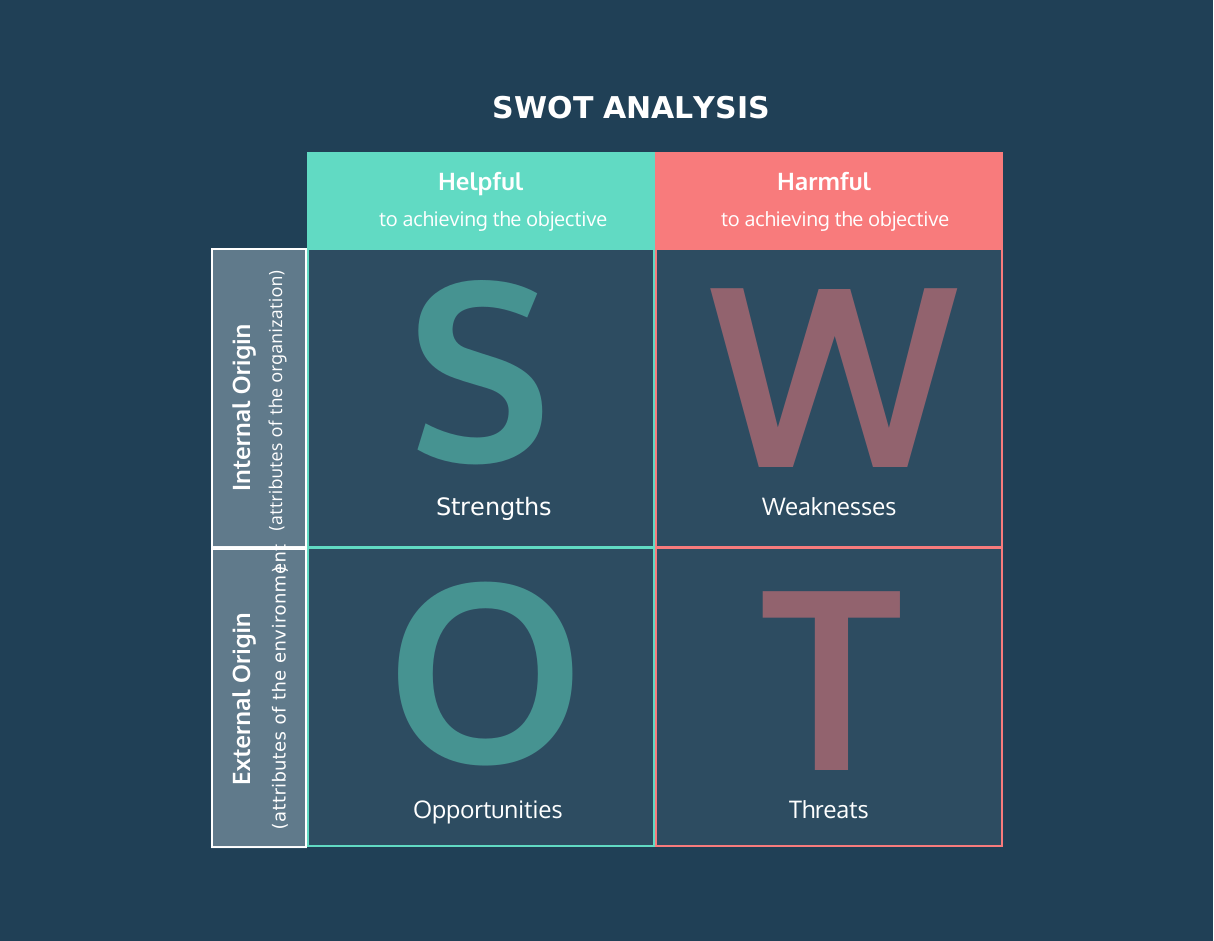
SWOT Analysis Diagram, explained in text below
The table above is broken into two rows and two columns. The top row represents attributes that are internal to the organization (strengths, weaknesses) and the bottom row represents external attributes (opportunities, threats). The left column represents helpful attributes (strengths, opportunities) and the right represents harmful attributes (weaknesses, threats).
Some people have natural tendencies to plan for negative situations, while others plan for more positive situations. Some are more focused internally, while others may be preoccupied with outside influences. SWOT analysis aims to overcome these individual differences in planning style by setting the expectation that strategic plans should account for both the good and the bad, as well as the internal and the external.
Though SWOT was developed for businesses uses, it can certainly also help guide other types of projects.
Before breaking down the situation according to the SWOT acronym, it is important to specify the business objectives. What are your business goals, and what are the key transactions that you want your users to make? This may change over the course of the SWOT analysis, but it’s good to be explicit about this beforehand so that everyone is on the same page.
A strength is an attribute that is internal to the organization and positive. Examples:
- Many returning customers.
- Positive reputation, as indicated by reviews on external sites like Yelp, and customer satisfaction surveys.
- Meeting revenue expectations.
- Increased traffic from social media referrals.
A weakness is an attribute that is internal to the organization and negative. Examples:
- Slower growth of new customers.
- Low conversion rate on website.
An opportunity is an attribute that is external to the organization and positive. Examples:
- Projected increasing demand due to changing demographics.
- Economies of scale that will increase profit margin as the company size increases.
- Conference series coming up could increase visibility with related businesses.
A threat is an attribute that is external to the organization and negative. Examples:
- A direct competitor has better search engine optimization (SEO) and therefore appears earlier in google searches.
- Effectiveness of additional marketing spending is unknown, due to limited analytics from the advertising partners.
After brainstorming each category of SWOT with your team, the goal is to then use this information to create actionable plans.
- How can strengths be turned into opportunities? Are there any ways to leverage what you are already doing well more broadly?
- How can weaknesses and threats be neutralized?
- Does the information gained in the SWOT analysis change your main business objectives?
- How does SWOT analysis impact your product design? Is there anything you can change about the user experience to improve any weaknesses, and align user motivations with company goals more effectively?
'The Codecademy Team, composed of experienced educators and tech experts, is dedicated to making tech skills accessible to all. We empower learners worldwide with expert-reviewed content that develops and enhances the technical skills needed to advance and succeed in their careers.'
Complete Payment to Unlock Full Guide & Source Code
You are viewing the 30% preview. Join TopCourseAI Pro to unlock the remaining 70% of this article, unblur all code snippets, and gain full access to all 412 technical projects and guides.
Ready to access the complete step-by-step tutorial?
Gain full unhindered access to all 412 technical projects and guides, unblur all source code snippets, and download runnable scripts.
Related Blueprints & Guides
View all 166 →CSS Glossary
Comments in CSS are signified by a forward-slash and asterisk.
Web designInline Styles in HTML
Usually, CSS is written in a separate CSS file (with file extension.css) or in a<style>tag inside of the<head>tag, but there is a third place which is also valid. The third place you can write CSS is inside of an HTML ta...
Web designManaging Assets and Icons
In this article, you will learn how to manage icons and assets using web-based tools.
Ready to build production-grade AI systems?
Enjoyed this guide? Continue exploring our library of 166+ production blueprints, multi-agent swarms, and autonomous agent systems with 100% unblurred, executable source code.