
What is Programming?
What is Programming?
PROGRAMMING IS EVERYWHERE
Programming is, quite literally, all around us. From the take-out we order, to the movies we stream, code enables everyday actions in our lives. Tech companies are no longer recognizable as just software companies — instead, they bring food to our door, help us get a taxi, influence outcomes in presidential elections, or act as a personal trainer.
When you’re walking down the street, where can you find technology in your environment? Click on the white circles.
…AND PROGRAMMING IS FOR EVERYONE
For many years, only a few people have known how to code. However, that’s starting to change. The number of people learning to code is increasing year by year, with estimates around31.1 million software developers worldwide, which doesn’t even account for the many OTHER careers that relate to programming.
Here at Codecademy, our mission is to make technical knowledge accessible and applicable. Technology plays a crucial role in our economy — but programming is no longer just for software engineers. Any person can benefit from learning to program — whether it’s learning HTML to improve your marketing emails or taking a SQL course to add a dose of analysis to your research role.
Even outside of the tech industry, learning to program is essential to participating in the world around you: it affects the products you buy, the legal policies you vote for, and the data you share online.
So, let’s dig into what programming is.
WHAT IS PROGRAMMING?
Put simply, programming is giving a set of instructions to a computer to execute. If you’ve ever cooked using a recipe before, you can think of yourself as the computer and the recipe’s author as a programmer. The recipe author provides you with a set of instructions that you read and then follow. The more complex the instructions, the more complex the result!
How good are you at giving instructions? Try and get Codey to draw a square!
PROGRAMMING AS COMMUNICATION, or CODING
“Ok, so now I know what programming is, but what’s coding? I’m here to learn how to code. Are they the same thing?”
While sometimes used interchangeably, programming and coding actually have different definitions.
- Programmingis the mental process of thinking up instructions to give to a machine (like a computer).
- Codingis the process of transforming those ideas into a written language that a computer can understand.
Over the past century, humans have been trying to figure out how to best communicate with computers through differentprogramming languages. Programming has evolved from punch cards with rows of numbers that a machine read, to drag-and-drop interfaces that increase programming speed, with lots of other methods in between.
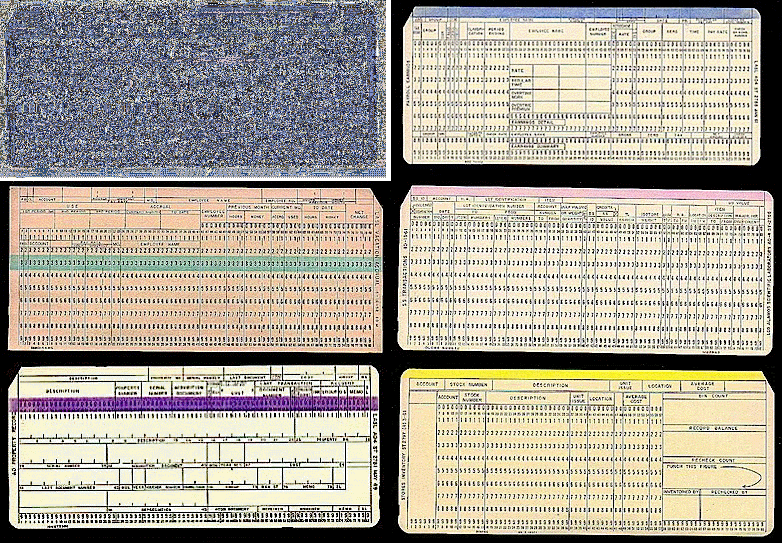
pictures of different punchcards
via GIPHY
To this day, people are still developing programming languages, trying to improve our programming efficiency. Others are building new languages that improve accessibility to learning to code, likedeveloping an Arabic programming languageor improving access for theblind and visually impaired.
There are tons of programming languages out there, each with its own unique strengths and applications. Ultimately, the best one for you depends on what you’re looking to achieve. Check out ourtips for picking your first languageto learn more.
PROGRAMMING AS COLLABORATION
“The problem with programming is not that the computer isn’t logical—the computer is terribly logical, relentlessly literal-minded.”
Ellen Ullman,Life in Code
When we give instructions to a computer through code, we are, in our own way, communicating with the computer. But since computers are built differently than we are, we have to translate our instructions in a way that computers will understand.
Computers interpret instructions in a very literal manner, so we have to be very specific in how we program them. Think about instructing someone to walk. If you start by telling them, “Put your foot in front of yourself,” do they know what a foot is? Or what front means? (and now we understand why it’s taken so long to develop bipedal robots…). In coding, that could mean making sure that small things like punctuation and spelling are correct. Many tears have been shed over a missing semicolon (;) a symbol that a lot of programming languages use to denote the end of a line.
But rather than think of this as a boss-employee relationship, it’s more helpful to think about our relationship with computers as a collaboration.
The computer is just one (particularly powerful) tool in a long list of tools that humans have used to extend and augment their abilities.
As mentioned before, computers are very good at certain things and well, not so good at others. But here’s the good news: the things that computers are good at, humans suck at, and the things that computers suck at, humans are good at! Take a look at this handy table:
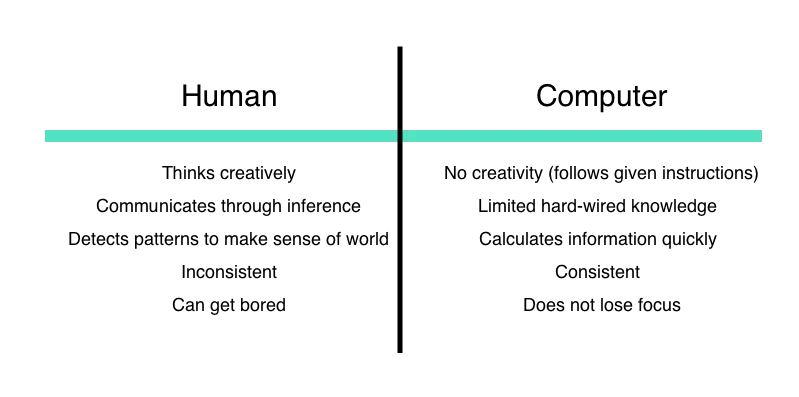
table comparing human and computer abilities
Just imagine what we can accomplish when we work together! We can make movies with incredible special effects, have continuous 24/7 factory production, and improve our cities and health.
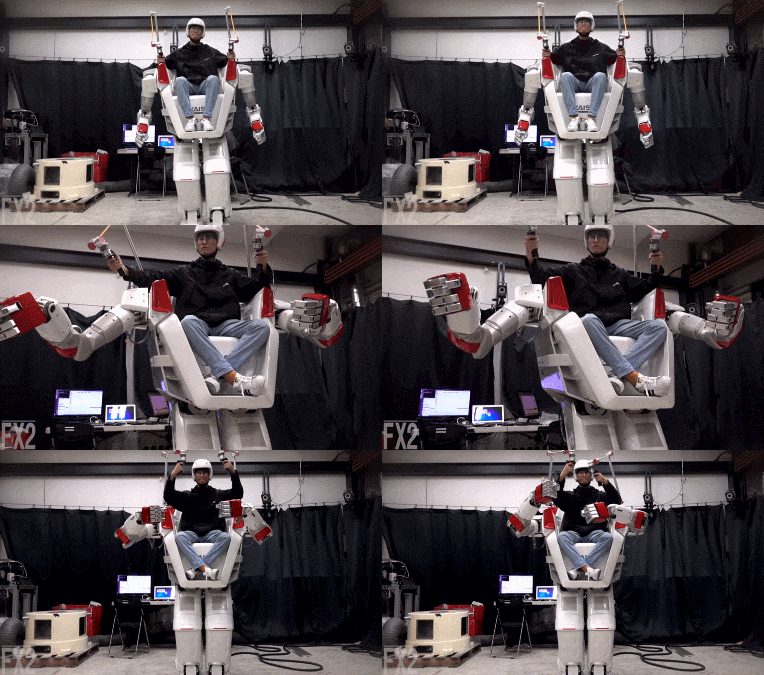
picture of a robot-human
via GIPHY
The best computer programs are the ones that enable us to make things that we couldn’t do on our own, but leverage our creative capacities. We may be good at drawing, but a computer is great at doing the same task repeatedly — and quickly!
Use your cursor to draw in the white box in order to see the program draw!
CONCLUSION
As programming becomes a larger part of our lives, it’s vital that everyone has an understanding of what programming is and how it can be used. Programming is important to our careers, but it also plays a key role in how we participate in politics, how we buy things, and how we stay in touch with one another.
Learning to code is an exciting journey. Whether your goal is to build a mobile app, search a database, or program a robot, coding is a skill that will take you far in life. Just remember — computers are tools. While learning to program may initially be frustrating, if you choose to stick with it, you’ll be able to make some brilliant things.
'The Codecademy Team, composed of experienced educators and tech experts, is dedicated to making tech skills accessible to all. We empower learners worldwide with expert-reviewed content that develops and enhances the technical skills needed to advance and succeed in their careers.'
Complete Payment to Unlock Full Guide & Source Code
You are viewing the 30% preview. Join TopCourseAI Pro to unlock the remaining 70% of this article, unblur all code snippets, and gain full access to all 412 technical projects and guides.
Ready to access the complete step-by-step tutorial?
Gain full unhindered access to all 412 technical projects and guides, unblur all source code snippets, and download runnable scripts.
Related Blueprints & Guides
View all 166 →Accessibility on the Platform
Codecademy is committed to providing a high-quality learning experience for all learners. That includes accommodating different usage forms such as auditory, motor, or visual restrictions, limited hardware, or other acce...
Web developmentAffordances, Signifiers, and Clickability
For users on the web, the mouse click is perhaps the most fundamental human-computer interaction. The webbecamethe web partially through the power ofhypertext, or text in one document that links to other documents or res...
Web developmentAuthentication and OAuth
Authenticationis the process used by applications to determine and confirm identities of users. It ensures that the correct content is shown to users. More importantly, it ensures that incorrect content is secured and u...
Ready to build production-grade AI systems?
Enjoyed this guide? Continue exploring our library of 166+ production blueprints, multi-agent swarms, and autonomous agent systems with 100% unblurred, executable source code.